
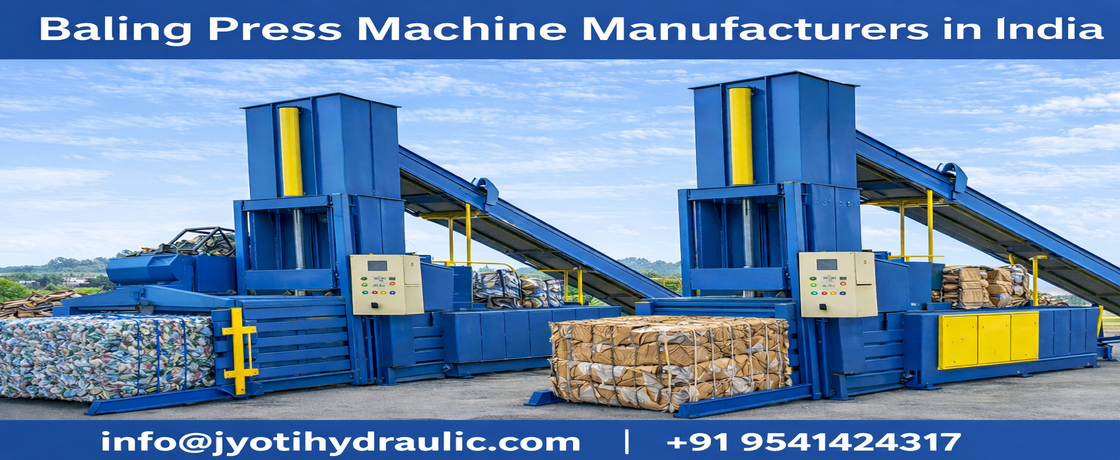
Jyoti Hydraulic understands that cardboard waste is no longer just a disposal issue—it is a daily operational challenge for warehouses, packaging units, printing businesses, retail chains, and recycling yards. A Hydraulic Single Box Baling Press Machine for Cardboard helps businesses convert bulky corrugated scrap into compact, high-density bales that are easier to store, handle, transport, and sell. For companies that want cleaner premises, lower logistics costs, and better scrap recovery, this machine is a practical and profitable investment.
In today’s recycling-driven economy, cardboard and carton waste moves in high volumes. E-commerce, manufacturing, FMCG distribution, and export packaging all generate used cartons every day, which is why demand for a Waste Paper Corrugated Box Baling Press Machine continues to grow. Recycling also matters at a larger level: Google’s current search guidance emphasizes people-first, trustworthy, genuinely useful content, and major environmental agencies continue to highlight the value of paper and corrugated recycling in reducing waste and supporting resource recovery.
Quick Answer: What Is a Hydraulic Single Box Baling Press Machine for Cardboard?
A Hydraulic Single Box Baling Press Machine for Cardboard is a heavy-duty hydraulic machine designed to compress loose cardboard, used cartons, corrugated sheets, and waste paper into tightly packed bales. These bales occupy less space, reduce handling time, and improve scrap resale value.
It is commonly used by:
- Corrugated box manufacturers
- Paper recycling units
- Warehouses and logistics centers
- Retail back-end operations
- Printing and packaging companies
- Industrial scrap dealers
This is one reason buyers often search for a Carton Baling Machines Manufacturer in India or trusted Baling Press Machine Manufacturers who can deliver both durability and after-sales support.
Industry Overview: Why Cardboard Baling Machines Are in High Demand
Cardboard waste is one of the most visible industrial and commercial waste streams. Every shipment, pallet movement, carton conversion process, and finished-goods dispatch creates usable but bulky scrap. Loose corrugated boxes quickly consume floor space, slow down material movement, and create housekeeping problems.
A cardboard baling system solves these problems at the source.
Why the market is growing
- More e-commerce means more cartons entering warehouses and returns centers
- Manufacturers are under pressure to improve waste handling efficiency
- Recyclers prefer dense, uniform bales over loose scrap
- Businesses want to reduce transport trips and labor costs
- Clean and organized shop floors improve safety and productivity
Corrugated boxes are also among the most widely recovered paper-based materials by tonnage, making them a core stream in recycling systems.
For Indian businesses, the need is even more practical: space is expensive, labor must be used efficiently, and scrap monetization matters. That is why many buyers compare Scrap Baling Machine Manufacturers in India before choosing a machine that matches their waste volume and operating cycle.
What Is a Hydraulic Single Box Baling Press Machine?
A single box baling press machine has one compression chamber where the material is loaded, pressed, compacted, and tied into a bale.
Unlike loose manual bundling, this machine applies hydraulic force to compress cardboard evenly. The result is a compact bale with better density and cleaner handling.
Core function
The machine:
- Receives loose cardboard or corrugated scrap into the chamber
- Uses a hydraulic ram to compress the material
- Reduces the volume significantly
- Allows bale tying for secure handling
- Releases a dense bale ready for storage or dispatch
This machine is ideal for businesses that generate regular cardboard waste but do not need a high-throughput automated baling line.
Technical Insights: Working Principle, Specifications, and Features
A strong blog should not just describe the machine—it should help the buyer understand how it performs in real working conditions.
How the machine works
The working principle is simple but powerful:
- Cardboard waste is fed into the single chamber
- A hydraulic cylinder drives the pressing platen downward or forward, depending on design
- Pressure builds gradually and compresses the material
- Once target density is reached, the bale is tied manually or semi-manually
- The finished bale is ejected or removed for stacking
Typical specifications buyers look for
The exact configuration depends on capacity, but most users evaluate:
- Bale size
- Chamber size
- Pressing force
- Motor capacity
- Hydraulic power pack performance
- Cycle time
- Daily throughput
- Bale weight range
- Machine footprint
- Ease of loading and bale ejection
Important features that improve performance
When comparing Baling Press Machine Manufacturers, look beyond price and check for features such as:
- Rugged steel body construction
- High-pressure hydraulic cylinder
- Low-maintenance hydraulic circuit
- User-friendly control panel
- Strong platen alignment
- Safety interlocks and emergency stop
- Reliable bale tying arrangement
- Consistent bale density
- Long service life under continuous use
A quality Waste Paper Corrugated Box Baling Press Machine should give repeatable output without excessive oil heating, uneven compression, or structural vibration.
Applications: Industries and Real-World Usage
A Hydraulic Single Box Baling Press Machine for Cardboard is used across many industries because cardboard waste is nearly universal.
1. Corrugated box manufacturing units
These businesses generate trim waste, rejected sheets, damaged cartons, and production leftovers. A baler turns that scrap into saleable recycled material.
2. Warehouses and logistics hubs
Distribution centers often face mountains of secondary packaging. Instead of storing flattened cartons in corners, they can bale them daily and free up valuable floor space.
3. Retail chains and supermarkets
Back-end retail operations handle packaging waste from incoming stock. A baler keeps the area clean and improves waste segregation.
4. Printing and packaging industries
Paper board offcuts, corrugated sheets, and misprinted packaging can all be compacted efficiently.
5. Scrap collection and recycling yards
Recyclers need dense, transport-friendly bales to increase truck payload efficiency and improve resale handling.
Real-world example
A mid-sized warehouse handling FMCG dispatches may generate several trolley loads of empty corrugated cartons every shift. Without a baler, that material spreads across the floor, needs repeated manual sorting, and takes up storage space. With a single box baling press, the same waste is compacted into stackable bales, reducing clutter and improving dispatch discipline.
Key Benefits of a Cardboard Baling Press Machine
The real value of the machine lies in daily savings and process control.
Better space utilization
Loose cardboard occupies massive volume. Baling reduces that volume dramatically, which helps businesses reclaim storage and movement space.
Lower handling and transport cost
Dense bales are easier to lift, count, stack, and dispatch. Fewer trips are needed to move the same amount of scrap.
Higher scrap resale value
Buyers of recyclable waste usually prefer sorted, compact bales over loose material. Better form often means better commercial value.
Cleaner and safer workplace
Piles of used cartons attract dust, block passages, and increase fire-load concerns. Baled material is neater and easier to control.
Improved labor productivity
Instead of spending hours flattening, bundling, and stacking loose cartons, staff can follow a standard baling process.
Stronger sustainability image
Businesses that bale and recycle cardboard demonstrate practical waste responsibility. Recycling paper-based materials helps conserve resources and supports a more circular material economy.
Buying Guide: How to Choose the Right Machine
Buying the wrong baler can create more problems than it solves. Capacity mismatch, weak construction, or poor service support can hurt output and ROI.
1. Assess your waste volume
Ask:
- How much cardboard is generated per day?
- Is the waste mostly cartons, corrugated sheets, or mixed paper?
- Is generation continuous or batch-based?
A smaller operation may do well with a compact single box machine, while larger facilities may eventually need a double box or higher-capacity solution.
2. Check bale weight requirements
If your recycler prefers a certain bale size or weight, choose a machine designed to meet that requirement consistently.
3. Evaluate available floor space
Single box balers are often preferred where space is limited. This makes them highly suitable for warehouses, stock rooms, and factory corners.
4. Focus on build quality
The frame, platen, cylinder, power pack, seals, and controls must be designed for tough operating conditions.
5. Compare support and service
A dependable Carton Baling Machines Manufacturer in India should offer:
- Installation guidance
- Operator training
- Spare parts support
- Maintenance assistance
- Fast response for breakdowns
6. Look for long-term value, not just low price
Many buyers compare multiple Scrap Baling Machine Manufacturers in India, but the cheapest machine may cost more later in downtime, oil leakage, poor bale density, or structural wear.
Single Box vs Double Box Baling Press Machine
This comparison helps buyers make faster decisions.
Single Box Baling Press
Best for:
- Medium waste volume
- Limited floor space
- Lower initial investment
- Simpler operation
- Cardboard, cartons, and waste paper
Advantages:
- Compact design
- Cost-effective
- Easy to operate
- Suitable for many SMEs and warehouses
Double Box Baling Press
Best for:
- Higher throughput
- Continuous operation
- Facilities with multiple waste streams
- Users needing faster loading and pressing cycles
Advantages:
- Better productivity for larger operations
- Reduced waiting time between loads
- Higher output in busy recycling environments
For many businesses handling mainly corrugated waste, the Hydraulic Single Box Baling Press Machine for Cardboard is the most balanced choice in terms of cost, performance, and simplicity.
Maintenance and Safety Tips
A well-maintained baler performs better, lasts longer, and remains safer for operators.
Maintenance best practices
- Check hydraulic oil level regularly
- Inspect hoses, seals, and fittings for leakage
- Lubricate moving parts as recommended
- Keep the chamber clean and free from trapped debris
- Monitor unusual noise, pressure loss, or slow ram movement
- Tighten electrical and structural fasteners during scheduled checks
- Replace worn components before failure
Safety tips for operators
- Train operators before machine use
- Never overload the chamber beyond design limits
- Keep hands away from moving compression areas
- Use the machine only with guards and controls functioning properly
- Switch off power before servicing
- Follow lockout procedures during maintenance
- Use proper bale tying tools and PPE
A trusted manufacturer does not just supply a machine—it supplies operating confidence.
Future Trends in Baling Technology
The baling industry is evolving from basic compression to smarter, more efficient waste handling.
Trends to watch
- PLC-based control systems for better cycle consistency
- HMI displays for easier operator monitoring
- Energy-efficient hydraulic systems
- Higher bale density with optimized ram design
- Condition monitoring for preventive maintenance
- Integration with recycling workflow data
- Faster bale ejection and easier tying systems
As buyers become more quality-conscious, Baling Press Machine Manufacturers that combine mechanical strength with smart controls will have a competitive edge.
Why Businesses Choose Jyoti Hydraulic
When businesses look for a Carton Baling Machines Manufacturer in India, they are not just buying steel and hydraulics. They are choosing reliability, productivity, and support.
Jyoti Hydraulic stands out by focusing on:
- Robust machine construction
- Application-based machine selection
- Practical engineering for industrial use
- Consistent compression performance
- Customer-focused guidance
- Dependable service support
For buyers who need a Waste Paper Corrugated Box Baling Press Machine that performs in real production environments, subtle details like chamber strength, hydraulic stability, and user-friendly design make a major difference.
Conclusion
A Hydraulic Single Box Baling Press Machine for Cardboard is one of the smartest investments for businesses dealing with carton, corrugated box, and waste paper scrap. It improves housekeeping, reduces waste volume, lowers handling cost, increases scrap value, and supports sustainable recycling operations.
Whether you run a warehouse, packaging unit, recycling center, or industrial facility, the right baling solution can transform a messy waste stream into a structured revenue-supporting process. That is why more buyers are actively searching for reliable Scrap Baling Machine Manufacturers in India, experienced Baling Press Machine Manufacturers, and proven partners who understand both machine performance and operational reality.
If your goal is to improve waste handling efficiency, maximize cardboard recovery, and invest in a machine that delivers long-term value, a single box baling press is a practical and scalable choice.
FAQs: Hydraulic Single Box Baling Press Machine for Cardboard
1. What is the use of a hydraulic single box baling press machine for cardboard?
It is used to compress cardboard, cartons, and corrugated waste into dense bales for easier storage, handling, transportation, and recycling.
2. Who should buy a waste paper corrugated box baling press machine?
Warehouses, packaging companies, retail chains, recyclers, paper mills, scrap dealers, and manufacturing plants that generate regular cardboard waste should consider this machine.
3. How does a cardboard baling machine improve scrap value?
Loose scrap is difficult to handle and transport. Baled cardboard is cleaner, denser, and easier for recyclers to process, which often improves commercial value.
4. What is the difference between a single box and double box baling press?
A single box baler is compact and cost-effective for moderate waste volumes, while a double box baler is better for higher throughput and more continuous operation.
5. How do I choose the best carton baling machines manufacturer in India?
Check machine build quality, hydraulic design, chamber strength, service support, spare availability, operating ease, and whether the manufacturer understands your waste type and volume.
6. Is a hydraulic baling press machine suitable for only cardboard?
No. Depending on design, it can also handle waste paper, corrugated sheets, cartons, kraft scrap, and other dry recyclable materials.
7. Why is preventive maintenance important in a baling press machine?
Regular maintenance prevents hydraulic leakage, pressure loss, unexpected downtime, and unsafe operation. It also improves machine life and bale consistency.
Get a Quote from Jyoti Hydraulic
Need a powerful and dependable Hydraulic Single Box Baling Press Machine for Cardboard for your plant, warehouse, or recycling unit?
Connect with Jyoti Hydraulic today for a fast inquiry response, expert machine guidance, and a competitive quotation tailored to your waste volume and application. The right baling solution can start saving you space, labor, and money from day one.
Email: info@jyotihydraulic.com
Phone: +91 9541424317
Reach out now to request your quotation, discuss your requirement with an expert, and choose a machine built for real industrial performance.


